Topics
Speculation space
Synopsis of the speculative topics in the IgOme project, with links to more detailed notes. The topics contain established results, working hypotheses under active scrutiny as well as outlook to potential future projects.
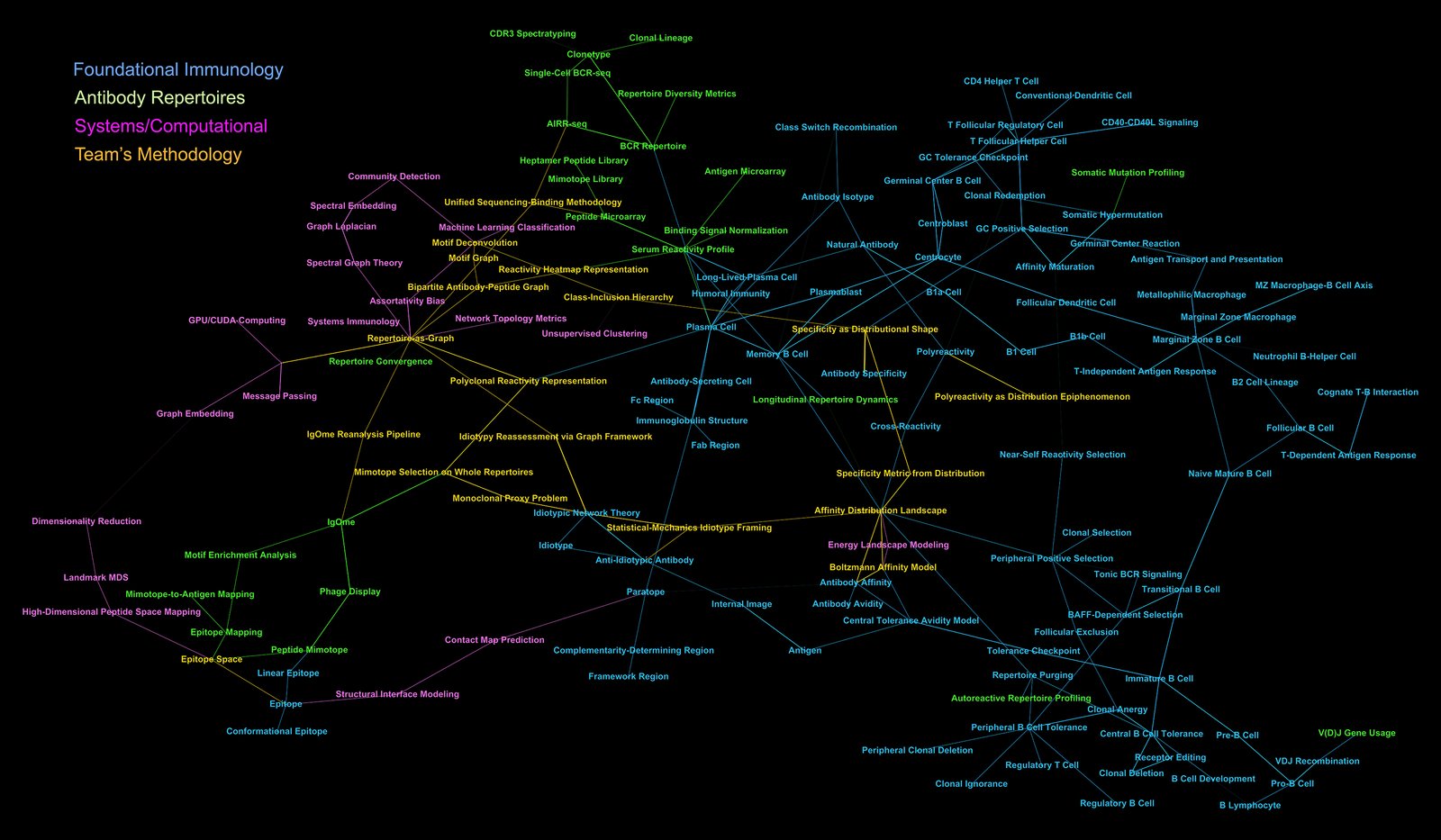
Specificity as a distribution
The conventional picture treats an antibody as specific for one epitope. A physics-flavoured alternative describes it by the distribution of binding free energies it realises across the whole space of epitopes. Specificity then becomes a property of that distribution’s shape — how peaked, how heavy-tailed.
\[ p(\varepsilon) \;=\; \frac{1}{Z}\, e^{-\beta\, E(\varepsilon)}, \qquad Z = \sum_{\varepsilon} e^{-\beta E(\varepsilon)} \]
A sharply specific antibody has a distribution dominated by a few low-energy epitopes; a polyreactive one spreads its weight broadly. Read the note →
Mimotope spaces
Peptide mimotopes selected on whole repertoires sample the functional binding landscape of the immunoglobulins in the blood as opposed to sequencing of the B cell receptors. The two approaches look at the antibody repertoire from non-overlapping viewpoints with nothing to bridge them yet. A library of mimotopes is a finite, noisy sample from a much larger reactivity space; the questions are how densely it covers that space and how to compare two such samples.
Key tools: phage display selection, NGS readout, representative sub-libraries, and string-distance metrics over the peptide alphabet. Read the note →
Graph representations
We represent the repertoire of reactivities as a graph: mimotope sequences are nodes, edges connect sequences sharing a common subsequence (e.g. 5 of 7 residues), or microarray reactivities linked by cross-reactivity. The graph’s community structure, spectral embedding, and topology then become measurable features.
\[ L \;=\; D - A, \qquad L\,\mathbf{v}_k = \lambda_k\, \mathbf{v}_k \]
Methods in rotation: modularity and CPM community detection, the Leiden algorithm, spectral graph analysis, and UMAP for visualization as well as non-negative matrix factorization for direct analysis of the binding data.
Repertoire physics
If individual antibodies are described by affinity distributions, the repertoire is an ensemble of such distributions. The total reactivity signal for a clone is a convolution of (1) the number of cells or molecules of that clone and (2) the clone’s affinity distribution shape across epitope space. The distribution itself depends on the chemical potentials of the antibodies and epitopes (the latter are often simplified out of the equation) and on the intrinsic affinity of each clonal antibody/epitope pair. Many of these parameters are not yet independently observable. That is why the IgOme observables are only the beginning of a much more complex experimental exploration of their mechanistic foundation. In the meantime, useful biomarkers can be validated on this basis. Furthermore, these observables can be studied as parameters describing the system as a whole.
The attempted mechnistic models are speculative, but speculative in a productive way: raising tolerance stringency must degrade coverage uniformity, so autoimmunity and immunodeficiency become restrictions in an optimization problem rather than two unrelated failures.
As speculative as it is, this hypothesis is no longer unfalsifiable. The concrete prediction is the \(Y_k\) collapse: for a condensed random‑energy measure all participation ratios follow from one measured number, \[Y_k=\Gamma(k-\mu)/[\Gamma(k)\Gamma(1-\mu)]\] with \(\mu=1-Y_2\)1. Either our profiles satisfy it or they do not.
The chemical‑potential half of this framework is prior art due to József Prechl, whose super‑landscape couples Gaussian interaction energies to exponentially distributed chemical potentials and predicts a scale‑free interaction network — close to what the variational problem above produces when coverage is enforced under a resource budget, and a correspondence worth pinning down term by term rather than by dictionary (2).
Does evolution ‘care’ about idiotypy?
IgOme maps show changes associated with autoimmune pathology with two recurrent features:
Loss of public IgM reactivities and
Non-random association with idiotypic reactivity.
Could we have a new tool at our disposal to study idiotypy in a more systematic way?